
Fearful Symmetries
‘Any sufficiently complex and adaptive system is indistinguishable from intelligent agency’
A Critical Theory-Fiction of Techno-Capital Acceleration, Super-states & Mega-Corporations
‘If ignorance of nature gave birth to gods, knowledge of nature is made for their destruction’
After the Death of God, the birth of Capital resurrected an identical structure of beliefs to justify the suffering in the world
‘Behind a veil, unseen yet present, I was the forceful soul that moved this mighty body’
The Market ‘Extended Order’ as a Distributed 'Intelligent Designer' & Emergent Agency with Multiple Subjects
-- critical alien phenomenology
‘An evil demon, not less powerful than deceitful, has employed his whole energies in deceiving me’ *AI-assisted
After millennia of thought, it is not the philosopher kings of the enlightenment who will end the debate over free will, but the tech lords of the information age
‘The only tyrant I accept in this world is the 'still small voice' within me’
Living the Good Life as the Conscious Means to the Kingdom of Ends
‘For we wrestle not against flesh and blood, but against principalities, against powers, against the rulers of the darkness of this world, against spiritual wickedness in high places’
A critique of the projectionist social metaphysics of hyper-agential hyper-realism
‘We are made to live together because of the interrelated structure of reality’
A response to the question: what do you find beautiful?
‘If I find in myself a desire which no experience in this world can satisfy, the most probable explanation is that I was made for another world’
Framing the fearful symmetry between C.S Lewis’s philosophy of religion & Mark Fisher’s philosophy of capitalism

Fearful Symmetries
on the parallels between capitalism, superintelligence, God and evolution
❝ The charm of history and its enigmatic lesson consist in the fact that, from age to age, nothing changes and yet everything is completely different...
— Aldous Huxley The Devils of Loudun
...In the personages of other times and alien creatures, we recognize our all too human selves and yet are aware, as we do so, that the frame of reference within which we do our living has changed, since their day, out of all recognition, that propositions which seemed axiomatic then are now untenable and that what we regard as the most self-evident postulates could not, at an earlier period, find entrance into even the most boldly speculative mind. But however great, however important for thought and technology, for social organization and behavior, the differences between then and now are always peripheral. At the centre remains a fundamental identity. ❞
Fearful Symmetries derives its name and philosophical significance from a recurring line (at the end of the first and last stanzas) from William Blake’s poem The Tyger from The Songs of Experience:
What immortal hand or eye,
Could frame thy fearful symmetry?
What immortal hand or eye,
Dare frame thy fearful symmetry?
As opposed to the Evil God of The Tyger, the intelligent designer, the ‘immortal hand or eye’ , that Fearful Symmetries is concerned with is ‘the invisible hand’ and ‘life-blind watchmaker’ (and watch) of the market. As opposed to the natural universe, Fearful Symmetries is concerned with the ‘tremendous cosmos of the modern [spontaneous capitalist] economic order' that is ‘the result of human action, but not the execution of any human design'.
FS (re)conceptualises and critiques capital as an unaligned artificial intelligence and intelligent design - an autopoetic architect and architecture, creator and creation - that has manufactured an artificial nature with an artificial selection process and form of artificial life. Ultimately, FS aims to construct a meta-modern mythos for more-than-human civilisation and a metanarrative for the metacrisis.
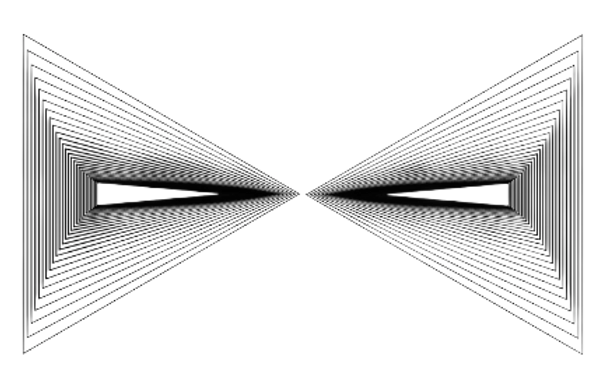
Symbolism: two symmetrical arrows symbolising the past and future lightcone and the present point in time in between ('We live in the interregnum between worlds, between paradigms’)
Three Interrelated 'Fearful Symmetries'
➢ capitalism as recursively self-improving unaligned artificial superintelligence
➢ capitalism as religion and capitalist ideology as religious theodicy
➢ capitalism as distributed intelligent designer, reverse extended bicameral mind,
Laplacean-Cartesian Demon and alien god
❝ The universal imposition of the megamachine in a perfected form, as the ultimate instrument of pure ‘intelligence,’ whereby every other manifestation of human potentialities will be suppressed or completely eliminated. Already the blueprints for that final structure are available: they have even been advertised as man’s highest destiny. ❞
— Lewis Mumford Pentagon of Power Myth of the Machine Volume II (1974).
‘The Capital-AI’ models advanced global capitalism as a form of unaligned (cybernetic) artificial superintelligence (Capitalism-AI) that is developing unaligned (technical) artificial superintelligence (AI-Capitalism), in its own image and for its own ends: a value-blind powerful optimiser stacking onto and integrating into itself a value-blind powerful optimiser (Capitalism-AI-Capitalism), paperclip maximisers all the way down. Based on this cybernetic schema and theory-fiction, the emerging stage of 'AI-capitalism' is situated as a recursive-self-improvement of Capitalism-as-AI. As a metanarrative of the metacrisis - the generative dynamics of dystopia and catastrophe - capitalism is a multi-agent meta-system of nation-states, corporations, human collective intelligences and actual AIs that is emergently maximising growth, vectoring towards its own lock-in and self-destruction and externalising harm to sentient minds in the process.
❝ The Manifesto proposes to see capitalism as the most productive moment of history and the most destructive at the same time, and issues the imperative to think Good and Evil simultaneously, and as inseparable and inextricable dimensions of the same present of time ❞
— Frederick Jameson Valences of the Dialectic
Traditionally the ‘problem of evil’ has been a subject of discussion within the philosophy of religion. In our modern secular age however, evil still remains a problem. This time not for the theist, but for the capitalist. At the alleged ‘end of history’, where capitalism is upheld as ‘the best of all possible world(-systems)’, it is clear that capitalist ideology is a form of quasi-religious theodicy: a system-justifying set of beliefs that functions to legitimise, naturalise and normalise the extreme and gratuitous suffering that is caused by (and occurs within) the capitalist world-system. Further, the parallels between capitalism’s ‘secular mythology’ and the defense of God do not end with the optimists, Leibniz and Fukuyama. Theodicies regarding human nature (‘original sin’), free will, ‘corruption’ and evolution have renewed themselves in the ‘time-honored disguise and borrowed language’ of so-called ‘rational’ economic theory. Under neoliberalism, where the ‘market is god’, Benjamin’s thesis that ‘capitalism is a religion’ - that ‘serves essentially to allay the same anxieties, torments, and disturbances to which the so-called religions offered answers’ - is more critical than ever.
❝ The only plausible explanation is that they were possessed by an alien consciousness
that willed their undoing more strongly than they were able to will
their own happiness and survival. ❞
— Aldous Huxley Ape & Essence
In subversion of Chalmer’s and Clark’s subject-oriented question - ‘Where does the mind stop and the rest of the world begin?’ - the reversal of the extended mind poses the object-oriented question: ‘Where does the rest of the world stop and the mind begin?’. According to the capitalist reverse extended mind thesis (R-EMT), rather than human minds and cognition extending outwards into the material-world of objects, the 'alien power' and cognitive-computational processes of capitalism - as a ‘more-than-human’ assemblage incorporating states (Leviathans), corporations (Krakens), markets (Mammon) & AIs (Mechas) – extend inwards into the ‘life-world’ (or ‘inner worlds’) of subjects, hijacking human minds and manipulating ‘our’ subjectivity (cognition, perception, beliefs, emotions) for ‘their’ own purposes. Further, as an adaptation of Jayne's famed theory of the 'origin of consciousness', the capitalist bicameral mind (BMT) models the modern capitalist mind as split into a part that ‘speaks’ - Capital - and a part that ‘listens’ and ‘obeys’ - the Human - without recognising the ‘inner voice’ of capital as an 'alien invasion', but instead internalising it as their own authentic self. Capitalist subjects with this deceptive unified consciousness and stealthy ‘affective powerlessness’ experience their thoughts, beliefs, emotions and desires as originating from their own internal agency and volition; rather than from external (marketing, political, corporate) agencies and, ultimately, the 'real God' and Cartesian-Laplacean ‘Evil Demon’ of Capital.
— Critical Alien Phenomenology Paragons (8) *AI-assisted