
.jpg)
The (inhuman) history of a memetic entity
❝ For we wrestle not against flesh and blood, but against principalities, against powers, against the rulers of the darkness of this world, against spiritual wickedness in high places ❞
— Ephesians 6:12
Etymology
{ Moloch }
from Latin Moloch, from Greek Molokh and in Hebrew molekh: from melekh "king" and basheth "shame" to express their horror of the idol’s worship.
Moloch-ian > ‘of Moloch’
the molochian dynamics of the metacrisis.
alt: ‘molochy’ (if you’re Liv Boeree ;)
Introduction
Molochian is a digital cultural artifact documenting the intellectual history (critical genealogy) of Moloch - the god of destructive competition (coordination failure, negative-sum game theory) - and means-ends reversal - the sacrifice of value (the good, the true and the beautiful) for survival and power.
Beginning with the biblical deity of child sacrifice and ending in the neo-exterminism of the AI arms race, Moloch (as all true gods are) is timeless; an archetype instantiated across historical, ethical and technological conditions. Furthermore, Moloch is transcendent and immanent; we are Moloch and Moloch is us, it becomes us and we become it, we act it out and it acts through us. We 'metaphorically' attribute causality and responsibility to an emergent demonic entity (‘it was Moloch that did it’) when no such entity actually exists; and yet ‘it’ effects the world as if it does. In this way, Moloch is an alienation of our individual and collective agency.
Whilst popularised by Scott Alexander's essay Meditations on Moloch (2014), which itself referenced Ginsberg's Howl (1955), the meme of 'Moloch' also appears notably in Lang's anti-capitalist film Metropolis (1927) and Huxley's post-apocalyptic novel Ape & Essence (1948) - under the name 'Belial'. Beyond the name of Moloch, the notion of (capitalist) civilisation as a 'world-spirit' and 'alien power' - a dark emergent agency - finds precedent in the critical philosophies of Adorno and Marx. The symbol and substance of Moloch has a rich intellectual history that is largely unrecognized. The purpose of this site is to excavate and present this history (in style ;)
Meta-notes: currently at 20+ nodes on the timeline, with 20 more in progress. See also wiki entries for Moloch and the Multi-polar Trap at SourceCodeX.
Recommended Materials: the the most sophisticated secondary scholarship on Moloch in my opinion comes from Jonah Wilberg's writings (at The Wider Angle on Substack and also posted on LessWrong).
Definition
Molochian trap (alt: multi-polar trap, coordination problem)
— a system of incentives where individually rational actions for competitive advantange in the short-term lead to collectively adverse outcomes in the long-term;
— where competing actors are incentivised into a "race to the bottom" that nobody wills but no one can unilaterally stop;
— a "bad Nash equilibrium" where no single actor can improve their situation by changing their strategy alone, so all actors remain locked in a suboptimal dynamic.
— the massively multiplayer negative-sum game that is techno-capitalist civilisation in the 21st century
— the nexus of game-theoretic intra-actions that is now exhibiting emergent agency in the direction of dystopia or oblivion.
Conceptual Cluster
—Traps
The Molochian Trap
The Hobbesian Trap (state of nature)
The Darwinian Trap (selection pressures)
The Goliath Trap (hypertrophied states)
The Multi-Polar Trap
The Social Trap (conflict of interest, perverse incentive)
—Dilemmas
The (Evolutionary) Prisoner’s Dilemma
The Security Dilemma (alt: The Spiral Model)
—Laws
Goodhart’s Law
Ginsberg’s Theorem
— Problems
The Coordination Problem
The Collection Action Problem
— Game-Theory
The Tragedy of the Commons
The Freerider Problem
The Race to the Bottom (Downregulation)
The Arms Race
The Red Queen Effect (e.g Fisherian Runaway)
— Other
Crab Mentality
The Tyranny of Small Decisions
❝ There is an internal dynamic and reciprocal logic here which requires a new category for its analysis. If "the hand-mill gives you society with the feudal lord; the steam-mill, society with the industrial capitalist," what are we given by those Satanic mills which are now at work, grinding out the means of human extermination? I have reached this point of thought more than once before, but have turned my head away in despair. Now, when I look at it directly, I know that the category which we need is that of "exterminism”. ❞
❝ And since you are talking about factories and industries, do you not see the tremendous factory hysterically spitting out its cinders in the heart of our forests or deep in the bush, the factory for the production of lackeys; do you not see the prodigious mechanization, the mechanization of man; the gigantic rape of everything intimate, undamaged, undefiled that, despoiled as we are, our human spirit has still managed to preserve; the machine, yes, have you never seen it, the machine for crushing, for grinding, for degrading peoples? ❞
— Discourse on Colonialism Aimé Césaire (1950)

Minotauromachy
by Pablo Picasso (1935)
6th Century BCE – The Catalogue of Women Hesiod
The Mythology of the Minotaur: An Ancient Greek Precursor
Prior to the Christian form of Moloch, the Greek myth of the Minotaur was an earlier manifestation: a bull-headed monster imprisoned in a labyrinth to whom 14 Athenian youth were tributed every nine years, compelled by King Mino. The Minotaur is symbolic of structural violence enforced by coercive hierarchical power—young lives consumed to ensure the continuity of the established political order.
❝ Pasiphaë gave birth to Asterius, who was called the Minotaur. He had the face of a bull, but the rest of him was human; and Minos, in compliance with certain oracles, shut him up and guarded him in the Labyrinth. ❞
❝ And the Lord spake unto Moses, saying, Again, thou shalt say to the children of Israel, Whosoever he be of the children of Israel, or of the strangers that sojourn in Israel, that giveth any of his seed unto Molech; he shall surely be put to death: the people of the land shall stone him with stones. And I will set my face against that man, and will cut him off from among his people; because he hath given of his seed unto Molech, to defile my sanctuary, and to profane my holy name. And if the people of the land do any ways hide their eyes from the man, when he giveth of his seed unto Molech, and kill him not: Then I will set my face against that man, and against his family, and will cut him off, and all that go a whoring after him, to commit whoredom with Molech, from among their people ❞
7th Century BCE – The Bible Leviticus 18:21
Sacrifice to the Idol: The Future for the Now
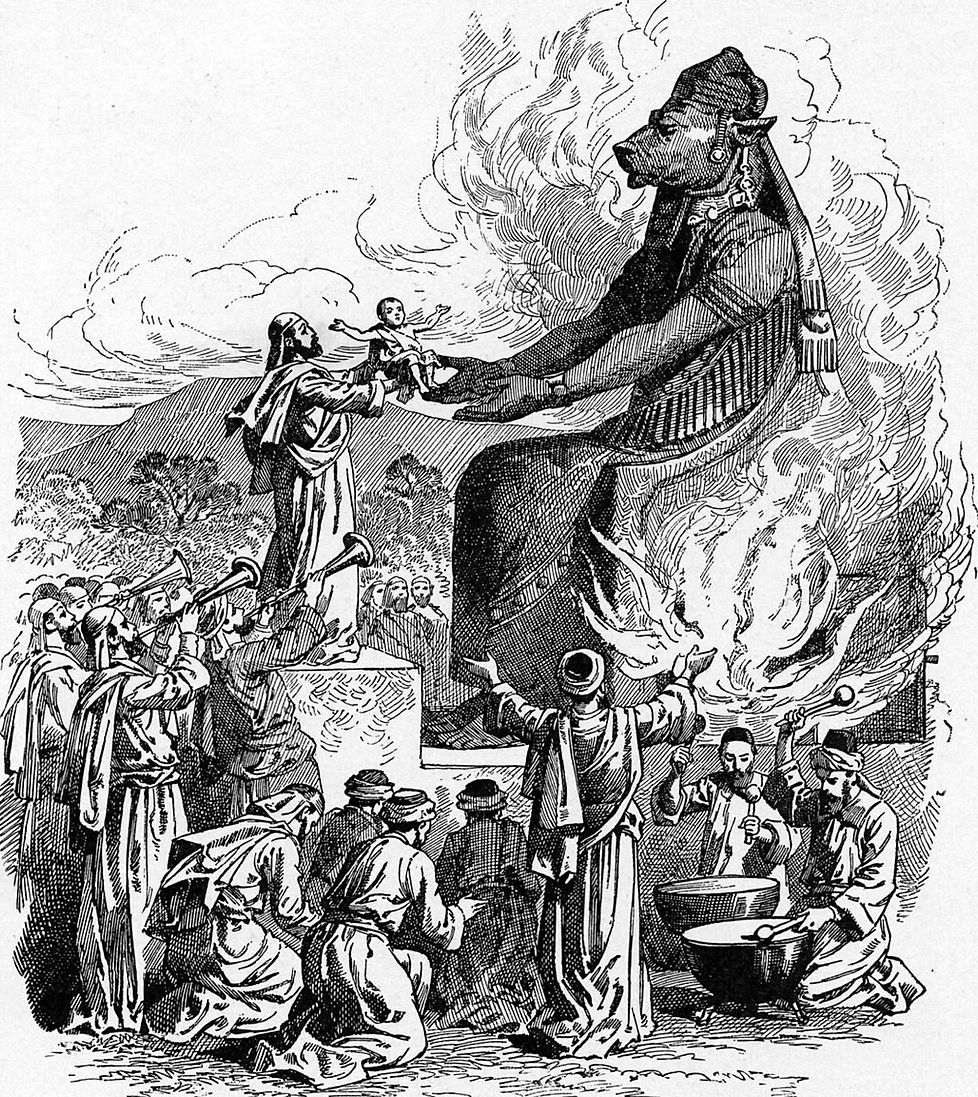
Moloch begins as an ancient deity - with a bull's head and human body - whose worship entailed child sacrifice through fire. In the old testament bible, Leviticus 18:21 prohibits the act: 'thou shalt not let any of thy seed pass through the fire to Molech'. Cultures, such as the Canaanites and the Phoenicians, would resort to this practice in times of crisis to appease the wrath and secure the favour of the divine. Children were paradoxically given as sacrificial offerings to Moloch in return for the fertility of the community and its land and livestock. This utilitarian sacrifice of future generations for survival and prosperity in the present later becomes archetypal of any action that perversely uses what should be the ends of civilisation - the lives of children - as means for narrower, self-interested and shorter-term goals.
John Milton Paradise Lost – 1667
The War Against Heaven
In the epic poem Paradise Lost, Milton’s Moloch manifests as a demon politician advocating for total war against heaven in the parliament of Hell. Moloch is the first speaker at Hell's council, embodying unreflective violence: "My sentence is for open war." He advocates suicidal assault on Heaven—"Which if not Victory is yet Revenge"—revealing the psychology of those willing to destroy everything for retribution. Milton's Moloch crystallizes the "unthinking man of action" who pursues escalation regardless and worse yet, for it's dire consequences.
❝
First Moloch, horrid King besmear’d with blood
Of human sacrifice, and parents tears,
Though for the noyse of Drums and Timbrels loud
Their childrens cries unheard, that past through fire
To his grim Idol.
…Of Solomon he led by fraud to build
His Temple right against the Temple of God
On that opprobrious Hill, and made his Grove
…To do him wanton rites, which cost them woe.
Yet thence his lustful Orgies he enlarg’d
Even to that Hill of scandal, by the Grove
Of Moloch homicide, lust hard by hate;
Till good Josiah drove them thence to Hell.
❞
❝ …the right to offer not only unwholesome lodging, but lodging in which it is physically impossible that human beings can exist without disease and degradation, has never been called in question.. Mercenary speculators have been allowed to do what they like with their own — that is to say, to take advantage of the influx of population, in order to run up rows of wretched hovels, streets built back to back, without drains or sewers, courts and wynds without ventilation, cities without a playground or breathing place. They have been allowed to crowd lodgers together pell-mell, without distinction of sex or age, to stow them away in cellars, to pack them five or six together in beds yet warm with the contagion of the typhus fever — in a word, to work the mine of misery as they could with most profit and least expense. In no particular have the rights of persons been so avowedly and shamefully sacrificed to the rights of property, as in regard to the lodging of the labouring class. Every large town may be looked upon as a place of human sacrifice, a shrine where thousands pass yearly through the fire as offerings to the Moloch of avarice. ❞
1844 – National Distress Samuel Laing
The Post-Malthusian Trap: Industrial Revolution as Sacrificial Machine
Critically commenting on rapid urbanisation, Laing draws the parallel between dangerous mass housing and ‘human sacrifice… to the Moloch of avarice’. Laing indicts Victorian housing as a place wherein property rights devour human lives. He identifies "mercenary speculators" exercise unchallenged freedom to "work the mine of misery"—extracting profit from population influx and constructing death-traps as an externality. Laing diagnoses the coordination problem: that as no law forbids such disregard of livable conditons for people, property owners are not compelled to do anything about it - and further that it would only be at there expense and, in turn detriment, in a competitive property marketplace where others will certaintly be more ruthless.

The Thirtieth of November: Destruction of the Crystal Palace by Fire
by Arthur Stead Crystal Palace Museum
1844 – Notes from Underground Fyodor Dostoyevsky
The Crystal Palace: Baal’s Cold Utilitarian Rationality
Summoning the same god under a different name, Dostoyevsky employs Baal as the subject of worship by the crowds of The Crystal Palace: a vast transparent architecture in London ( "Babylon, some prophecy being fulfilled before your very eyes") housing the Great Exhibition of frontier industrial technology emblematic of the cold utilitarian rationality of capitalist development. The palace is portrayed as a deterministic prison where "2+2=4" becomes a tyrannical inevitability crushing human freedom. The Underground Man's rebellion preserves the capacity to deviate and defy systems leveraging the ideology of mathematical certainty: "twice two makes five is sometimes a very charming thing too".
❝ You look at these hundreds of thousands, these millions of people obediently streaming here from all over the earth — people coming with a single thought, peacefully, insistently and silently crowding into this colossal palace and you feel that something final has been accomplished, accomplished and brought to a close… You feel it would require a great deal of eternal spiritual resistance and repudiation not to surrender, not to succumb to the impression, not to bow down to fact and not to idolize Baal, that is, not to accept what exists as your ideal. ❞
❝ And you, father, you press your fingers upon the little blue metal plate near your right hand, and your great glorious, dreadful city of Metropolis roars out, proclaiming that she is hungry for fresh human marrow and human brain and then the living food rolls on, like a stream, into the machine-rooms, which are like temples, and that, just used, is thrown up..."❞
1927 – Metropolis Fritz Lang
The Temple of Moloch: Into the Maws of the Machine God
In the defining scene of Metropolis, a german expressionist film that became a classic of science-fiction, the protagonist Freder witnesses a catastrophic industrial accident killing multiple workers. Before his eyes, the machinery transforms into a colossal temple resembling Moloch—a demonic entity with gaping mouth atop pyramid-like stairs. Workers march in lockstep formation up into the consuming maws, mirroring their earlier procession into factory elevators. Lang makes explicit that the 'machine process' (Veblen) is one that brutally demands the sacrifice of flesh and blood to sustain production.
1945 – The Trinity Test Robert Oppenheimer
Oppenheimer & the Gita
When the world's first atomic bomb detonated at the Trinity test site in the New Mexico desert, Robert Oppenheimer witnessed humanity crossing a threshold into potential self-annihilation. According to his later recollection, he recited the Bhagavad Gita. Vishnu attempts to persuade the Prince to perform his duty. The original Sanskrit speaks of Time (Kala) as world-destroyer, emphasizing the inevitable cycle of creation and destruction. Like the prince, Oppenheimer performs his duty to the Manhattan Project and to US supremacy in the nuclear arms race. As a consequence, the first atomic bombs deployed in combat utterly obliterated Hiroshima and Nagaski leaving only mushrooms clouds - the ultimate exterminist icon, Moloch's fire ascending, now capable of consuming entire civilizations.
Oppenheimer and the Gita by Alex Wellerstein (2014)
❝ Now I am become Death, the destroyer of worlds. ❞
❝ If the radiance of a thousand suns were to burst at once into the sky, that would be like the splendor of the Mighty One. ❞
Ape & Essence
The cover of Aldous Huxley's 1948 novel Ape & Essence depicting the prodigious bust of a demonic ape glaring at a nakedly vulnerable Adam and Eve.
.jpg)
❝ And then there was Nationalism - the theory that the state you happen to be subject to is the only true god, and that all other states are false gods; that all these gods, true as well as false, have the false, have the mentality of juvenile delinquents; and that every conflict over prestige, power or money is a crusade for the Good, the True and the Beautiful. The fact that such theories came, at a given moment of history, to be universally accepted is the best proof of Belial’s existence, the best proof that at long last He’d won the battle. ❞
1948 – Ape & Essence Aldous Huxley
The World Spirit of Catastrophe (Belial)
In Ape & Essence, Huxley envisions a post-apocaylptic religion in which adherents worship Belial—the Devil as a world-historical force— through conducting ritualized infant sacrifice of radiation-mutated babies. The Arch-Vicar explains the Church of Belial's theology: "The longer you study modern history, the more evidence you find of Belial's Guiding Hand." And it's central doctrine: "Progress—the theory that you can get something for nothing..." Huxley brings to bear in his social critique of the dawning nuclear age a Victorian industrial vignette (humans as apes serving machinery) with the insight that what is deemed 'progress' within modernity will inexorably culminate in extermination if it is not thwarted by the better angels of our nature.
1955 – Howl Part II Allen Ginsberg
Moloch Whose Mind is Pure Machinery
Ginsberg's peyote vision on October 17, 1954—seeing San Francisco's Sir Francis Drake Hotel as "child-eating demon"—crystallized into Part II of "Howl," the definitive post-war articulation of Moloch as American industrial-military-capitalist totality. Ginsberg explicitly credits Fritz Lang's Metropolis and 1950s America. The system isn't an external oppressor but an internalized subjectivity —we are Moloch's consciousness. Ginsberg's diagnosis: capitalism, militarism are not necessarily free choices, but consequences of an autonomous logic His repetition resembles liturgy: naming the demon doesn't exorcise it, but rather reveals how completely it possesses us. "Howl" identifies modernity's core horror— systems predicated on endemic sacrifice achieving totalization. Ginsberg sees machinery, money, military, all merged into civilization-as-devourer.
Howl by Allen Ginsberg The Poetry Foundation
❝ Moloch whose mind is pure machinery! Moloch whose blood is running money! Moloch whose fingers are ten armies! Moloch whose breast is a cannibal dynamo! Moloch whose ear is a smoking tomb! Moloch who entered my soul early! Moloch in whom I am a consciousness without a body! ❞
1980 – Notes on Exterminism: The Last Stage of Civilisation E.P Thompson
The Death Drive of Exterminism
❝ World War Three could burst out as 'something that no one willed'; the resultant of competing configurations of social forces. ❞
❝ impulsive exterminism began to grow an exterminist mind and will. ❞
❝ Nuclear weapons (all weapons) are things: yet they, and their attendant support-systems, seem to grow of their own accord, as if possessed by an independent will. Here at least we should reach for that talisman, "relative autonomy." ❞
British historian and peace activist E.P. Thompson, leader of European Nuclear Disarmament, theorizes the Cold War nuclear escalation as world-historical, self-destructive process transcending rational actors: Thompson introduces the concept of "Exterminism" designating "those characteristics of a society— ...within its economy, its polity and its ideology—which thrust it in a direction whose outcome must be the extermination of multitudes." Thompson notes that neither superpower wants annihilation, but they are simply "two antagonistic collocations... interlocked by their oppositions". Simultaneously, in a poetic and Marxist-derivative turn, Thompson remarks on how exterminism exists in it's own historical awareness and the conscious choices of those in each power bloc. Thompson's "exterminism" updates Moloch for the nuclear age as a globalised and militarized political economy becoming semi-autonomous; where locally rational decisions (weapons development, security policy) aggregate into globally catastrophic trajectory no individual intends or controls.
All That is Solid Melts into Air: The Experience of Modernity (1982)
The cover of Marshall Berman's book depicting the dark smoke of industrial development
1982 – All That is Solid Melts into Air: The Experience of Modernity Marshall Berman
Faustian Modernity: Overdevelopment & The Existential Price of 'Progress'
Berman draws on the modernist thought to diagnoses"the tragedy of development"— that human self-development and economic development are inextricably bound, and that both exact grave costs. Drawing on Goethe's Faust as the archetypal myth of modernity, Berman contends that "human powers can be developed only through what Marx phrased as 'the powers of the underworld,' dark and fearful energies that may erupt with a horrible force beyond all human control." Central to this is Mephistopheles, who reveals creation's implicit thermodynamic evil "nothing comes from nothing"—all creation requires "everything that you call sin, destruction, evil." Mephisto personifies the dialectic at modernity's core: "I am the spirit that negates all... "the power that would do nothing but evil, and yet creates the good" - "the road to heaven is paved with bad intentions." Berman constructs Moloch as the logic of capitalism itself: that there is no development without commensurate destruction, modern systems are constituted by the dialectic of creative destruction. Like Marx for whom the title of his book is owed, Berman sees capitalist modernity as a perpetual revolutionary process that deterritorialises everything without limit, undermining it's own conditions of possibility: "All that is solid melts into air".
How Marshall Berman reclaimed modernity for Marxists Owen Hatherley The Guardian (2013)
❝ Before the Molochs of the modern world could be effectively fought, it would be necessary to develop a modernist vocabulary of opposition...“Howl” was brilliant in unmasking the demonic nihilism at the heart of our established society, and revealing what Dostoevsky a century ago called “the disorder that is in actuality the highest degree of bourgeois order.” But all Ginsberg could suggest as an alternative to lifting Moloch to Heaven was a nihilism of his own. ❞
2014 – Meditations on Moloch Scott Alexander
Meditations on Moloch: What Does It?
Psychiatrist and rationalist blogger Scott Alexander reframes Ginsberg's Moloch as the systematic principle underlying all coordination failures or 'multipolar traps' as he frames them. Opening with Ginsberg's "Howl," Alexander asks: after C.S Lewis "What does it?" His answer: Moloch Alexander defines the core dynamic: "In some competition optimizing for X, the opportunity arises to throw some other value under the bus for improved X. Those who take it prosper. Those who don't take it die out. Eventually, everyone's relative status is about the same as before, but everyone's absolute status is worse than before." He catalogs fourteen examples, each demonstrates how locally rational individual decisions aggregate into globally catastrophic outcomes. The essay became the rationalist/EA movement's definitive articulation of existential risk from coordination failure, establishing "Moloch" as shorthand for multipolar traps generative of existential risk.
❝ Moloch is exactly what the history books say he is. He is the god of child sacrifice, the fiery furnace into which you can toss your babies in exchange for victory in war. He always and everywhere offers the same deal: throw what you love most into the flames, and I can grant you power. ❞
2017 – Inadequate Equilibria Eliezer Yudowsky
Moloch’s Toolbox: Unaffected Agents, Asymmetric Information; Bad Nash Equilibria
The original AI safety researcher Yudkowsky extends Alexander's multipolar trap analysis by examining why civilizations systematically fail to reach Pareto improvements—situations where everyone could be better off but coordination failures prevent it, "inadequate equilibria" Identifying these equilibria requires understanding not just that a system is broken, but why smart people haven't fixed it. Enter "Moloch's Toolbox"—the specific mechanisms preventing coordination: (1) situations where those with power to change systems don't face costs of dysfunction; (2) decision-makers are in a condition of asymmetric information (3) cases where everyone would benefit from change but can't coordinate. The framework became foundational for rationalist analysis of institutional dysfunction and X-risk.
❝ There’s a toolbox of reusable concepts for analyzing systems I would call “inadequate”—the causes of civilizational failure, some of which correspond to local opportunities to do better yourself. ❞
Darth Maul from Star Wars
A merciless Sith Lord resembling a demon and wielding a red double-sided lightsaber
.png)
2020 – Converting Moloch from Sith to Jedi on The Stoa Daniel Schmachtenberger
Converting Moloch from Sith to Jedi
Systems theorist and philosopher Daniel Schmachtenberger reframes the Moloch problem as fundamentally about "rivalrous dynamics" in multi-agent systems, offering potential solutions through "anti-rivalrous" coordination mechanisms. Schmachtenberger asks: can we design systems that align individual and collective interests? Moloch emerges from competition (zero-sum or negative-sum games) where advantage-seeking behavior produces collective harm. The solution requires transitioning to anti-rivalrous ('omni-win') dynamics where individual success enhances collective wellbeing. Against both techno-optimist faith that AI will solve coordination problems and doomer conviction that existential catastrophe is inevitable, Schmachtenberger argues human agency remains: we can design choice architectures steering action towards a positive-sum civilisation.
❝ Rivalrous (win-lose) games multiplied by exponential technology self terminate... Exponential tech cant be put back in the bag, so we figure out anti-rivalrous games or the human experiment completes. ❞
Moloch as Capital: Overfitting Optimisation Processes
MIT physicist and Future of Life Institute co-founder Max Tegmark, following the controversial open letter calling for a six-month pause in advanced AI development, identifies capitalism and AI as manifestations of the same Molochian optimization process. Tegmark draws on mathematical proofs showing that narrow-goal optimization follows a predictable trajectory generating externalities in the process. Capitalism's logic now drives AI development itself: a system optimizing for profit developing AI in it's own image, the ultimate expression of late-stage capitalism. The capitalist system driving AI development makes voluntary pause nearly impossible: companies that pause lose competitive advantage to those that don't, recreating the multipolar trap. Tegmark's intervention marked a moment when AI x-risk discourse explicitly merged with anti-capitalist analysis, recognizing both as the same optimization demon.
Why do people who worry about the existential risks of AGI refuse to talk about capitalism? by Mark Carrigan (2023)
❝ Pretty much all AI systems optimize. . .and it is almost impossible to give AI exactly the right directions to optimize. Capitalism is exactly like that... The issue with capitalism and the issue with AI have kind of merged now. The Moloch I talked about is exactly the capitalist Moloch. We have built an economy that has optimized for only one thing, profit. And that worked great back when things were very inefficient and now things are getting done better and as long as the companies were small enough that they couldn’t capture the regulators. But that is not true anymore, but they keep optimizing. So they realize that these companies can make even more profit by building ever more profitable AI even if it is reckless. So this is Moloch again showing up. Anyone who has any concerns about late stage capitalism having gone a little too far, you should worry about super intelligence cause it is the same villain in both cases. It is Moloch. ❞
❝ There wasn’t yet a unified theory about something that’s driving all of those interconnected effects... In the case of social media, we see — shortening of attention spans, more isolation and individual time by ourselves in front of screens, more addiction, more distraction, more polarization, less productivity, more focusing on the present, less on history and on the future, more powerlessness, more polarization, more radicalization, and more breakdown of trust and truth because we have less and less of a shared basis of reality to agree upon. ❞
2023 – The Social Dilemma Center for Humane Technology Tristan Harris
The Social Dilemma: Ascendence of Attention Economy
Former Google design ethicist Tristan Harris in the documentary The Social Dilemma exposes how platform competition creates race to the bottom for human attention: each platform must maximize engagement or lose users and advertisers to competitors. This drives deployment of increasingly sophisticated manipulation: algorithmic amplification of outrage, variable reward schedules exploiting dopamine systems, endless scroll removing natural stopping points, carefully crafted notifications interrupting focus. Harris demonstrates how the current techno-capitalist model of social media escalates a crisis of mental health (especially teen depression/suicide) and social epistemology (filter bubbles, conspiracy theories), undermining social cohesion and democratic legitimacy. As a pro-social alternative, Harris' Center for Humane Technology advocates "time well spent" metrics, duty of care for users, and treating attention as scarce resource requiring protection.

Liv Boeree as Moloch
A feminine portrayal of Moloch as the goddess of 'the beauty wars', reminiscent of Snow White's doomed mantra, 'mirror mirror on the wall'.
2023 – The Dark Side of Competition in AI TEDx Liv Boeree
The Dark Side of Competition in AI
Former professional poker champion and rationalist Liv Boeree applies game theory insights to AI development identifying it as the ultimate Molochian race in the 21st century: even companies wanting safe AI face pressure to cut corners when competitors move faster. With current AI development there is no regulatory floor preventing catastrophic risk-taking, first-mover advantages are everything, and safety research can't keep pace with capabilities research when capabilities capture all market value. Boeree effectively translate concerns about AI x-risk for mainstream audiences, advocating for coordination towards a win-win future: as she often puts it, 'wisdom is knowing which games to play in the first place'.
❝ Sometimes we get so lost in winning the game right in front of us, we lose sight of the bigger picture and sacrifice too much in our pursuit of victory. ...AI development has all the hallmarks of a Moloch trap. Imagine you're a CEO who, in your heart of hearts, believes that your team is the best to be able to safely build extremely powerful AI. Well, if you go too slowly, then you run the risk of other, much less cautious teams getting there first... ❞
2024 – The Darwinian Trap: The Hidden Evolutionary Forces That Explain Our World (and Threaten Our Future) Kristian Ronn
Darwin Among the Demons: The Dangers of Runaway Artificial Selection
Rønn introduces the handle "Darwinian demons" to emphasise unguided selection processes as the generator function of existential risks: "trial-and-error optimization algorithm" prioritizing immediate survival over all else. When any system exhibits variation, selection, and retention, demons emerge producing strategies that are adaptive, but ultimately detrimental. Rønn identifies three existential arms races driven by Darwinian forces: resources (stone axes to harvesters destroying half of species), power (stone axes to nuclear weapons and engineered pandemics), and intelligence (AI as technology that creates technologies, removing human limits on lethality). Against techno-optimism, he distinguishes technical AI misalignment from civilizational misalignment: AI aligned to misaligned human institutions and agents. Rønn's contribution is to ground Moloch evolutionary theory showing coordinatin failure as a predictable property of selection processes—Darwin among the demons, to steal a turn of phrase from Butler's 1863 Darwin Among the Machines.
❝ Darwinian demons are selection pressures that drive short-sighted, goal-oriented behaviors, which, over time, can lead to widespread net-negative consequences. Alternative terms for this phenomenon include multipolar traps, Moloch, coordination problems, social dilemmas, race to the bottom, and the tragedy of the commons. I chose the term 'Darwinian Demons' to emphasize its evolutionary roots ❞
2024 – Collective Action Problems in Introduction to AI Safety, Ethics and Society Dan Hendrycks
Formalising Generalised Darwinism: Evolutionary Pressures in Multi-Agent Systems
AI safety researcher Dan Hendrycks formalizes conditions under which evolutionary pressures in multi-agent systems push toward dangerous equilibria. The chapter systematically catalogs collective action problems in AI: corporate races where competitors accept 33% probability of catastrophe (Attrition model), military automation creating flash wars beyond human control (Security Dilemma), and economic automation proceeding to autonomous economies where humans lose leverage entirely. Hendrycks directly cites Scott Alexander's "Meditations on Moloch" as source for core concepts, marking full integration of rationalist coordination-failure analysis into mainstream AI safety research.
❝ A group of agents is engaged in a competition over a valuable and limited item (sunlight access, housing quality, military security). One way an agent can gain more of this valuable item is by sacrificing some of their other values (energy for growth, social life, an education budget). Agents who do not make these sacrifices are outcompeted by those who do. Natural selection weeds out those who do not sacrifice their other values sufficiently, replacing them with agents who sacrifice more, until the competition is dominated by those agents who sacrificed the most. These agents gain no more of the valued item they are competing for than did the original group, yet are worse off for the losses of their other values. ❞
.webp)
Moloch atop his throne
by Midjourney, from Jonah Wilberg's article Who is Moloch, really?
2025 – Who is Moloch, really? The View from Evolutionary Game-Theory The Wider Angle Jonah Wilberg
Who is Moloch, really? The View from Evolutionary Game-Theory
Philosopher Jonah Wilberg challenges the standard interpretation of Moloch as generic collective action problems, arguing that Scott Alexander's essay points to something more specific and conceptually novel: the Evolutionary Prisoner's Dilemma (EPD): — the dynamic evolutionary process where cooperators are systematically eliminated from populations. EPD models an indefinitely large population where individuals play either cooperate or defect strategies, with payoffs determining reproductive success; the replicator equation proves cooperation inevitably declines to zero unless starting conditions are 100% cooperators, a "race to the bottom" continuing to the stable 100% defection state. Like a river flowing downhill to sea-level. Against critics claiming Moloch anthropomorphizes and aggregates problems unhelpfully, Wilberg argues EPD represents a unifying frame — explaining the attractor states of civilsation through universal evolutionary dynamics.
❝ ‘Meditations on Mot’ relies heavily on the standard interpretation of Moloch as a wide range of collective action problems. But if we interpret Moloch through the lens of EPD, as I’ve been suggesting, it’s a lot easier to see the ‘unifying force’ at work. Moloch-aka-EPD is clearly a unifying model that purports to explain the macroscopic features of our civilizational and even cosmic trajectory - at least as a first approximation, which is the way mathematical models generally work in science. ❞
2025 – Cybersynergetic: A Literature Map of Civilisational Superintelligence Alignment Max Ramsahoye
The Evolutionary Process Alignment Problem: Replicators All the Way Down
Cybersynergetic is a central archive – a techno-cultural artifact – documenting the conceptual explosion in the discourse surrounding AI alignment (control and interpretability) where this frame has been extended to states, corporations, capitalism and civilisation as a whole.
The Evolutionary Process (Replicators) Alignment Problem is the second largest category on the site (with 23 entries) including materials from many notable theorists and papers (Gradual Disempowerment, Intelligence Curse) within EA/AI that have been pointing to, but have not formulated the problem as accurately as this framing.
Through curating core excerpts, the project brings a decade-long discourse into a unified multi-scale framework — across Alexander's multipolar traps, Christiano's influence-seeking patterns, Emilsson's pure replicators, Carlsmith's locusts. Bostrom's value erosion, Hanson's grabby aliens, Drexler's grey goo and Dawkins's selfish genes.
Against a narrow focus on future AGI takeover scenarios, Cybersynergetic reframes the alignment problem as already instantiated in world-system dynamics where replicators at every organizational scale interact symbiotically and parasitically, pursuing 'evolutionary stable strategies' that inadvertently vector towards the depths of 'the moral landscape'.
❝ The Evolutionary Process (Replicators) Alignment Problem -extends and synthesises AI alignment theory with universal darwinism to recognize that misalignment is fundamental to optimization processes across all scales of organization ('replicators all the way down'), where units (genes, memes, capital, grey goo, probes), agents (individuals, families, states, corporations, religion etc.) and systems (capitalism, civilisation) all amorally optimize for their own self-preservation and self-propagation – extending into boundless self-maximisation – generating externalities to sentio-centric values in the process; due to overriding instrumental convergence (terminal divergence) or means-ends reversal.❞

%20reprint%20of%20Ginsberg%E2%80%99s%20Howl!.webp)
'The idol Moloch with seven chambers or chapels'
in Die Alten Jüdischen Heiligthümer by Johann Lund (1704)
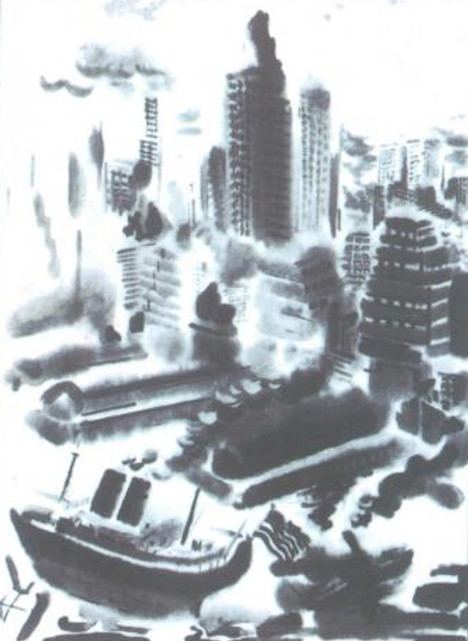
Moloch whose skyscrapers stand in the long streets
Illustration by Lyn Ward for the (1978) reprint of Ginsberg’s Howl!
.jpg)
.jpg)
The Temple of Moloch
Cabiria (1914)
The Temple of Moloch
Metropolis (1927)